Disclosure: This post contains affiliate links. We may earn a commission at no extra cost to you. We only recommend products we’ve tested and trust.
Buyer’s Guide
Shamim Sarker
Senior Editor, Displays & Desktop Hardware
Quick Answer
For most desktop PCs in 2026, a 27-inch monitor at 1440p resolution with a 144Hz+ refresh rate and an IPS panel hits the best balance of image quality, performance, and price. Match resolution to your GPU: budget and mid-range cards pair best with 1080p or 1440p, while high-end GPUs can drive 4K comfortably.
Expert Summary
A 27-inch, 1440p, 144Hz+ IPS panel is the current sweet-spot recommendation for most desktop PC builds in 2026.
Pixel density on a 27-inch panel jumps from 81 PPI at 1080p to 108 PPI at 1440p and 163 PPI at 4K.
Entry-level GPUs (RTX 4060 / RX 7600 tier) pair best with 1080–1440p at 60–144Hz; mid-range GPUs (RTX 4070/5070, RX 7700 XT) suit 1440p at 144Hz+; high-end GPUs (RTX 4080/5080/5090) can realistically drive 4K.
Meaningful HDR performance typically starts around HDR600 certification or on OLED/Mini-LED panels — entry-level HDR400 often looks no different from standard SDR.
2026 budget tiers run from under $200 (24-inch 1080p) up to $900+ (4K OLED, high refresh rate, ultrawide/super-ultrawide).
Introduction
Why Your Monitor Matters as Much as Your GPU
A few years ago, I built a new desktop PC around a solid mid-range graphics card and figured I’d just grab “whatever monitor” to pair with it. Big mistake. I ended up with a 4K display that my GPU couldn’t push past 45 frames per second in anything demanding, and I spent the next six months staring at choppy motion in games that should have felt buttery smooth. The GPU wasn’t the problem. The monitor was.
That experience taught me something most buying guides skip over: a monitor isn’t a standalone purchase. It’s the other half of a system, and if it doesn’t match your desktop’s graphics card, your use case, and your desk setup, you’ll either overpay for pixels you can’t use or underbuy and bottleneck a perfectly good PC. This guide walks through exactly how to choose a monitor for a desktop PC in 2026, in the order that actually matters. If you’re assembling the rest of your system from scratch, our step-by-step guide to building a PC covers the other components in the same practical order.
Buying Guide
What to Look For When Choosing a Monitor
Should I match my monitor to my desktop’s GPU?
This is the step almost every generic monitor guide skips, and it’s the one that will save you the most money and frustration. Your monitor’s resolution and refresh rate should be chosen around what your graphics card can realistically deliver — not the other way around.
GPU tier matched to recommended monitor resolution and refresh rate for a desktop PC
Entry-level and budget GPUs (RTX 4060 / RX 7600 tier and below): a 1080p or 1440p monitor at 60–144Hz is the sweet spot. Pushing 4K with a budget GPU means turning down every setting just to hit playable frame rates, which defeats the purpose of a sharper screen.
Mid-range GPUs (RTX 4070/5070, RX 7700 XT/9070 tier): this is where 1440p at 144Hz+ genuinely shines — sharp, fast visuals without demanding more than the card can give.
High-end GPUs (RTX 4080/5080/5090 tier): 4K becomes realistic, especially for single-player and creative work, though even top-tier cards can struggle to hit very high frame rates at 4K in the most demanding new titles.
If you’re not gaming at all — spreadsheets, browsers, and video calls — this step matters less, and you can prioritize resolution and screen size for comfort instead of frame rate. Not sure where your card lands? Check current frame-rate benchmarks for your exact GPU model at TechPowerUp’s GPU database, or see our RTX 5070 vs. RTX 5080 buying guide for a head-to-head at each resolution.
One more thing almost every generic guide leaves out: confirm your monitor supports adaptive sync that matches your GPU. NVIDIA cards want G-Sync Compatible; AMD cards want FreeSync. Adaptive sync eliminates screen tearing and stutter, and it matters more for smooth-feeling gameplay than chasing a higher refresh rate number on its own.
What screen size fits my desk?
Screen size and desk space go hand in hand, and it’s easy to get this wrong in either direction. A monitor that’s too big for your desk depth forces you to sit too close, which causes eye strain and neck fatigue over long sessions. Too small, and you’re squinting or constantly zooming.
22–24 inches works well for compact desks, secondary monitors, or budget office setups.
27 inches has become the standard sweet spot for both work and gaming on a desktop PC. It’s large enough to feel immersive without needing you to sit far back.
32 inches and up suits people with deeper desks, multiple open windows, or creative work like video editing — but pairing a 32-inch screen with a low resolution makes text and icons look soft, so size and resolution need to be chosen together.
Ultrawide (34-inch and larger, 21:9 aspect ratio) can replace a two-monitor setup for many users, especially traders, writers, and multitaskers, but it demands significant desk width and a GPU capable of pushing extra horizontal pixels. See our picks in Best Ultrawide Monitors for Desktop PCs if this fits your setup.
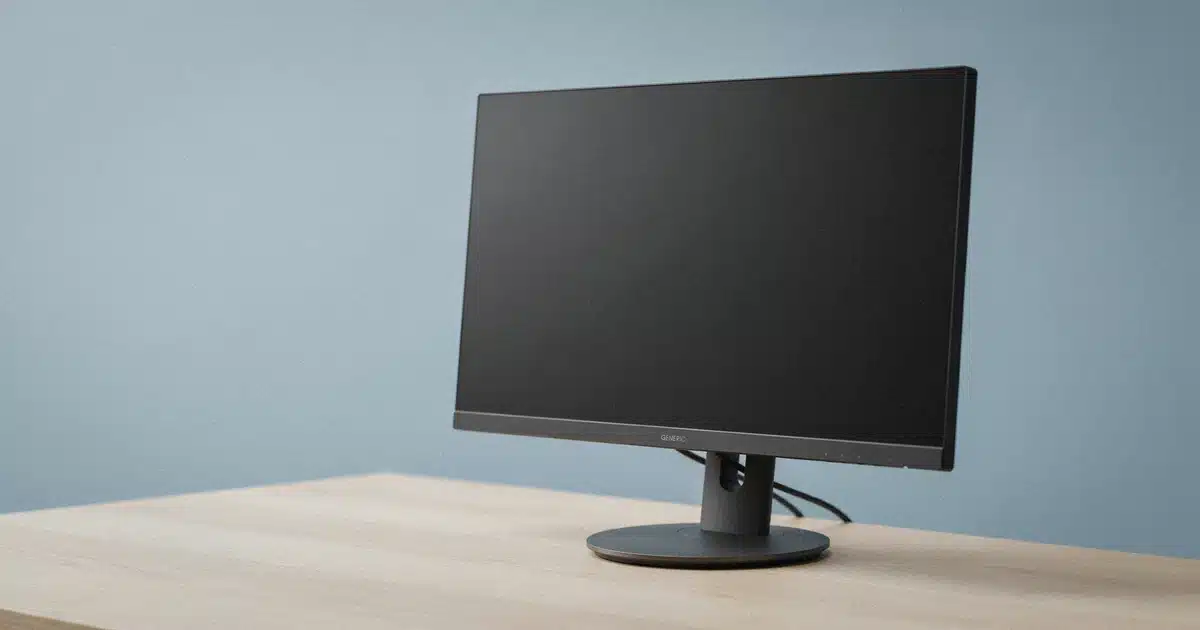
A 27-inch monitor is the current desk-size sweet spot for most desktop PC setups.
A rule of thumb I use when testing setups: measure your actual desk depth before buying. If you sit less than 24 inches from the screen, staying at 27 inches or under keeps the viewing experience comfortable without needing to constantly turn your head.
Is 1440p or 4K better for a desktop PC?
Resolution determines how sharp your text, images, and games look, and it needs to scale with screen size — a high resolution on a small screen is wasted money, and a low resolution on a big screen looks blurry.
1920 x 1080 (Full HD / 1080p): Still perfectly fine for 22–24 inch monitors, budget builds, or fast-paced esports gaming where high frame rates matter more than pixel-level detail. On anything larger than 24 inches, though, 1080p starts to look noticeably soft.
2560 x 1440 (QHD / 1440p): The current sweet spot for 27-inch monitors and the most common recommendation for desktop PCs with a mid-range GPU. It offers a real jump in sharpness over 1080p without demanding as much graphics horsepower as 4K.
3840 x 2160 (4K / UHD): Best suited to 27–32 inch screens for professionals who need crisp text and fine detail — photo editors, video editors, and anyone working with dense spreadsheets. For gaming, 4K requires a genuinely powerful GPU to maintain smooth frame rates, and even flagship cards can hit limits in demanding titles.
5K and 8K: Reserved for specialized professional work. For the vast majority of desktop PC users in 2026, 8K remains a marketing headline more than a practical upgrade — there’s very little native content, and even top-end GPUs are still GPU-limited at that resolution.
The pixel density (PPI) math matters more than raw resolution alone. A 27-inch 1080p monitor sits around 81 pixels per inch, which is noticeably soft at normal sitting distance. The same size at 1440p jumps to roughly 108 PPI, which looks crisp. Bump that same 27-inch panel to 4K and you’re around 163 PPI — sharper still, but with diminishing returns unless you’re doing detail-critical work.
Pixel density (PPI) roughly doubles in sharpness perception from 1080p to 4K on the same 27-inch panel
If you edit photos or video, resolution alone won’t tell the full story — check color gamut coverage too. Look for at least 99% sRGB for general creative work, and 90%+ DCI-P3 (or a factory-calibrated color profile) if you’re doing color-critical video or print work. A sharp panel with a weak color gamut will still misrepresent your colors.
Which panel type should I choose — IPS, VA, or OLED?
Panel technology affects color accuracy, contrast, viewing angles, and motion clarity — and it’s just as important as resolution, even though it gets less attention.
IPS (In-Plane Switching): The most common choice for desktop monitors today. Strong color accuracy and wide viewing angles make it a safe, versatile pick for both work and gaming.
VA (Vertical Alignment): Delivers deeper contrast and better black levels than IPS, which makes dark scenes in movies and games look richer, though viewing angles and motion clarity are usually a step behind IPS.
OLED: Offers the best picture quality available right now — true blacks, instant response times, and excellent motion clarity. Prices have come down significantly, and burn-in concerns for normal mixed use are largely overstated thanks to modern pixel-shift protection, though it’s still worth avoiding hours of fully static content (like a frozen taskbar) without protective settings enabled.
Mini-LED: A strong middle ground for HDR performance, offering much brighter highlights than standard IPS or VA panels while avoiding some of OLED’s static-image concerns.
Panel type affects color, contrast, and motion clarity as much as resolution does.
If you’re buying primarily for office work and web browsing, panel type matters less — any of these will look fine. If you’re gaming or watching a lot of video content, OLED or a high-quality IPS panel will give you the most noticeable upgrade. For a deeper breakdown, see our full guide to monitor panel types.
What refresh rate do I actually need?
Refresh rate measures how many times per second your monitor updates the image, and a higher number means smoother motion. But more isn’t always better for your specific use case.
60–75Hz is genuinely sufficient for office work, web browsing, and general productivity.
100–144Hz is the everyday sweet spot for most desktop PC users, including casual and mid-tier gaming — the smoothness upgrade over 60Hz is immediately noticeable.
165–240Hz benefits competitive gamers playing fast shooters or esports titles, where reaction time and motion clarity translate into real gameplay advantage.
280Hz and beyond is largely aimed at top-tier competitive players and often requires dropping to 1080p to actually hit those frame rates consistently.
Don’t buy a 240Hz monitor if your GPU can only push 90 frames per second in your games — you won’t see the benefit, and that budget is better spent on resolution, panel quality, or the GPU itself.
Refresh rate has a close cousin worth checking too: response time, usually listed as gray-to-gray (GtG) in milliseconds. A high refresh rate paired with a slow panel (think 5ms or higher on a budget VA screen) can still show motion blur or ghosting. For fast-paced gaming, look for 1ms GtG (common on IPS, VA, and virtually all OLED panels); for general work and casual play, anything under 5ms is fine.
Is HDR worth it on a desktop monitor?
HDR (High Dynamic Range) promises richer color and contrast, but certification tiers vary wildly in what they actually deliver. Entry-level “HDR400” certification is common on budget monitors but often doesn’t provide a meaningfully different experience from standard SDR content. Meaningful HDR performance typically starts around HDR600 and above, or on OLED and Mini-LED panels with genuinely high peak brightness. (See VESA’s official DisplayHDR certification criteria for how each performance tier is defined.)
For desktop use specifically, Windows’ HDR implementation has historically been inconsistent outside of full-screen video and games. Unless your monitor has strong HDR credentials (HDR1000+ or an OLED panel), many users find leaving HDR off for everyday desktop use looks more consistent than switching it on.
DisplayPort or HDMI — which do I need?
This is another area competitors barely touch, but it directly affects whether your desktop PC can actually use your monitor’s full capability.
DisplayPort 2.1 carries significantly more bandwidth than older standards (see VESA’s official DisplayPort specification) and is increasingly necessary for high-refresh 4K monitors to run at their full resolution and refresh rate simultaneously.
HDMI 2.1 supports high refresh rates at 4K as well, and is the standard most desktop GPUs and monitors ship with today, but always double-check your specific GPU and monitor both support the version you need — HDMI 2.0 ports are still common on older or budget hardware and will bottleneck a high-refresh 4K panel.
USB-C with DisplayPort Alt Mode: Increasingly common on newer monitors, useful if you want a single-cable connection for both video and device charging, though less relevant for most standard desktop tower setups.
Check your GPU’s actual output ports before assuming your monitor’s spec sheet applies.
Before buying, check your desktop’s actual GPU output ports, not just the monitor’s spec sheet — a mismatch here is one of the most common (and most avoidable) buying mistakes.
What ergonomics and desk-fit features matter?
A great panel wasted on poor ergonomics still leads to a bad daily experience. Look for:
VESA mount compatibility if you plan to use a monitor arm — this frees up desk space and makes height/tilt adjustment far easier than a stock stand, and most standard desktop-friendly monitors support the common 100x100mm VESA pattern.
Height, tilt, and swivel adjustment on the included stand, especially if you’re using a single monitor for long work sessions.
Curved vs. flat: Curved panels can feel more immersive and slightly more comfortable for very wide or ultrawide screens (34 inches and up), but they cost more at equivalent size and specs, and the benefit shrinks significantly below that size threshold.
Multi-monitor setups: If you’re considering two monitors instead of one large one, check that your desktop GPU has enough compatible outputs, and that your desk has room for proper spacing to avoid excessive neck turning.
A VESA-compatible monitor arm makes height, tilt, and swivel adjustment far easier than a stock stand.
Pros: Best balance of sharpness and performance, wide GPU compatibility, ideal for 27-inch screens
Cons: Requires a mid-range GPU or better for smooth high-refresh gaming, slightly pricier than 1080p equivalents
Choosing 4K
Pros: Excellent sharpness and detail, best for professional and creative work, strong for large screens
Cons: Demands a powerful GPU for gaming, higher price point, marginal benefit for pure office use
Choosing OLED over IPS
Pros: Best-in-class contrast, true blacks, near-instant response time
Cons: Higher cost, requires basic precautions against static-image burn-in for heavy desktop use
Budget Tiers for 2026
Tier
Price
Specs
Popular Lines
Budget
Under $200
24-inch 1080p, IPS or VA panel, 75–100Hz
Dell S-series, Acer Nitro/VG, ASUS VA-series
Mid-range
$200–$450 ✓
27-inch 1440p, IPS panel, 144Hz+
LG UltraGear, Dell G-series, ASUS TUF Gaming
Premium
$450–$900
27–32 inch 1440p/4K, OLED or high-end IPS/Mini-LED, 144–240Hz, strong HDR
LG OLED, Samsung Odyssey OLED, ASUS ProArt
Flagship
$900+
4K OLED, high refresh, ultrawide/super-ultrawide, top-tier HDR
Samsung Odyssey flagship, LG UltraGear OLED 4K, ASUS ROG Swift OLED
Not sure which tier fits you? If you mainly browse, work in spreadsheets, or run a secondary screen, budget is fine. If gaming or general productivity on a mid-range GPU is your main use, mid-range is the sweet spot for almost everyone. Premium and flagship tiers are worth skipping unless you already own (or plan to own) a high-end GPU that can actually drive the extra resolution and refresh rate.
Our Top Picks
Budget
Budget Pick: 24″ 1080p IPS/VA Monitor
Great for office work, budget builds, and secondary monitors. Popular lines include Dell’s entry-level S-series, Acer’s Nitro/VG series, and ASUS’s VA-series.
Ideal for enthusiasts, creative professionals, and serious gamers. Shop OLED options from LG, Samsung’s Odyssey OLED series, or high-end Mini-LED panels from ASUS ProArt.
Best reserved for high-end desktop builds that can actually drive these panels. Look at Samsung’s flagship Odyssey line, LG’s UltraGear OLED 4K panels, and ASUS ROG Swift OLED.
If you’re buying one monitor for a desktop PC in 2026 and want the safest, highest-value recommendation, go with a 27-inch, 1440p, IPS panel at 144Hz or higher. It matches what most mid-range desktop GPUs can actually drive, looks sharp for both work and play, and holds its value well if you upgrade your graphics card down the road. Step up to 4K only if you have a high-end GPU or do detail-critical creative work, and consider OLED specifically if picture quality and gaming responsiveness matter more to you than budget. Whatever you choose, buy the monitor to match your GPU and desk — not the other way around, and not based on spec-sheet numbers alone.
Frequently Asked Questions
What size monitor is best for a desktop PC?
27 inches offers the best balance of screen real estate and comfortable viewing distance for most desktop setups. Go smaller (24″) for compact desks, or larger (32″+) for deeper desks and creative work.
Is 1440p or 4K better for a desktop PC?
1440p is the better all-around choice for most users, offering sharp visuals without demanding as much GPU power as 4K, which is better reserved for high-end builds or detail-focused professional work.
What refresh rate do I actually need?
Most desktop PC users are well served by 100–144Hz, which offers a clearly noticeable smoothness upgrade over 60Hz. Only competitive gamers typically need to go higher.
Is curved better than flat for a desktop monitor?
Curved monitors feel more immersive on larger ultrawide screens (34 inches and up), but the benefit is minor on standard 27-inch monitors and usually not worth the added cost at that size.
Should I buy an OLED monitor for my desktop PC?
OLED delivers the best picture quality available today, with true blacks and excellent motion clarity — a strong choice for gaming and media. Just budget for it and take basic precautions against static-image burn-in.
Do I need DisplayPort or is HDMI good enough?
Both can support high resolutions and refresh rates, but DisplayPort 2.1 offers more bandwidth for high-refresh 4K setups. Always confirm your specific desktop GPU and monitor both support the connection standard you need.
Should I wait for 8K monitors instead of buying now?
Not for most users. 8K remains largely GPU-limited even on flagship graphics cards, and there’s minimal native 8K content, so 4K at a high refresh rate currently offers better real-world value.
Is HDR worth it on a desktop monitor?
Only on monitors with strong HDR certification (HDR600 and above, or OLED/Mini-LED panels). Entry-level HDR400 certification often doesn’t provide a meaningfully different experience from standard SDR.
How do I know if my GPU can handle a 4K monitor?
Check current benchmarks for your specific GPU model at 4K resolution. Look at the content type you use most — gaming, video editing, or productivity — since GPU demands vary significantly by task.
What’s the ideal viewing distance for a 27-inch monitor?
Roughly 20 to 28 inches from your eyes for comfortable viewing, though this can be adjusted based on your personal comfort and desk depth.
Do I need G-Sync or FreeSync for my desktop monitor?
Match adaptive sync to your GPU brand — G-Sync Compatible for NVIDIA, FreeSync for AMD. It eliminates screen tearing and stutter, and most modern monitors support both.
What response time should I look for in a monitor?
1ms gray-to-gray (GtG) is ideal for fast-paced gaming. For general work and casual gaming, anything under 5ms is perfectly fine.
Conclusion
Choosing a monitor for your desktop PC in 2026 comes down to matching four things: your GPU’s real-world capability, your desk space, your primary use case, and your budget. Start with your graphics card, pick a resolution and refresh rate it can actually drive, choose a panel type suited to how you’ll use the screen, and don’t overspend on specs you won’t notice. Get those four factors aligned, and you’ll end up with a setup that feels balanced instead of bottlenecked in one direction or the other.
Ready to See Specific Model Picks?
Browse our top-rated monitors for every budget and use case.